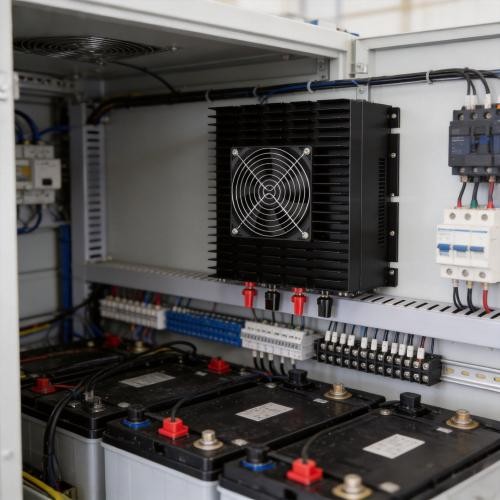
As subsidy-driven installations hit record highs, Chinese battery energy storage system manufacturers are reshaping Australia's energy landscape — and the DC-DC converters inside them are becoming the critical bottleneck for performance.
Australia's Home Battery Boom by the Numbers
Australia's residential energy storage market is experiencing unprecedented growth in the first half of 2026. According to data from SunWiz, monthly installations reached 1.6 GWh in March and surged to 2.4 GWh in April 2026 — both all-time records, compared to a 2025 monthly average of just 0.4 GWh.
The driver is clear: the Australian Government's Cheaper Home Batteries Program (CHBP), launched in July 2025 with an initial budget of AUD 2.3 billion. Demand exceeded all projections, prompting the government to raise the budget to AUD 7.2 billion in December 2025, targeting 2 million household installations and 40 GWh of new storage capacity by 2030.
As of May 2026, over 350,000 home batteries have been installed under the program — more than the population of Canberra. The Clean Energy Council (CEC) projects 350,000 to 520,000 installations for the full year 2026, representing 8–12 GWh of residential storage — nearly double 2025's total of 4.79 GWh.
However, since the subsidy rate reduction took effect on May 1, 2026, monthly installations dropped to 1.51 GWh, signaling a transition from policy-driven surge to structural growth.
Chinese Manufacturers Dominate with Cost and Speed Advantages
The most striking development is the near-total displacement of non-Chinese brands. According to Australian distributors, over 90% of residential storage products now on the market come from Chinese manufacturers, up from a market previously led by LG Energy Solution and Tesla.
The competitive advantage rests on three pillars, as analyzed by Roland Berger:
· Cost Structure: Chinese manufacturers benefit from domestic lithium battery supply chains, with cell and pack costs 30%+ lower than overseas competitors.
· Product Iteration Speed: Rapid adaptation to market needs — high-voltage batteries, modular expansion, extended cycle life — aligning with the Australian trend of moving from 10 kWh toward 20 kWh+ systems.
· Channel Depth: Leading Chinese brands have embedded themselves into local installation ecosystems through partnerships with major distributors such as OSW, Solar Juice, Lawrence & Hanson, and Energy Spurt.
Maidian Energy (a fast-growing Chinese BESS brand) reported single-month market shares exceeding 50% in Australia, with an average share of 30–40% from Q4 2025 to present.
The Hidden Critical Component: DC-DC Converters in BESS Architecture
Behind every residential BESS installation lies a component that directly determines system efficiency, safety, and battery lifespan: the DC-DC converter.
In a typical Australian home energy storage system, DC-DC converters perform several essential functions:
· Battery management system (BMS) power supply: Providing isolated, regulated DC power to the BMS from the battery bus — typically 24V or 48V output from varying battery voltages (48V, 96V, or higher).
· Voltage level shifting: Bridging different voltage domains between battery banks (which may range from 48V to 800V depending on architecture) and the inverter's DC bus.
· Auxiliary power for monitoring and control: Supplying stable power to CAN bus communication modules, sensors, and protection circuits that require galvanic isolation from the main power path.
· Grid-tie inverter protection: Providing isolated power rails for the inverter's control electronics, ensuring 3000VDC+ isolation between the battery side and grid-connected components.
As Australian installations shift toward higher-capacity systems (20 kWh+) and higher battery voltages (to reduce current and cabling costs), the demands on DC-DC converters intensify:
· Wider input voltage range: Battery state-of-charge variation means input voltage can swing from 350V to 750V in a 96-string LFP system.
· Higher efficiency requirements: At 93%+ peak efficiency, heat generation inside sealed BESS enclosures is minimized — critical for Australia's hot climate.
· CAN bus integration: Modern BMS systems require real-time monitoring and control via CAN bus, which the DC-DC converter must support natively.
· Compact form factor: With more battery capacity in the same enclosure, every millimeter of internal space counts.
What This Means for Australian System Integrators
For Australian BESS integrators and inverter manufacturers sourcing from Chinese supply chains, the message is clear: the DC-DC converter is no longer a commodity component you can overlook.
System-level performance — efficiency ratings, safety certifications, thermal behavior under Australian summer conditions, and BMS integration quality — all depend heavily on the DC-DC converter specification.
Key selection criteria for BESS DC-DC converters in the Australian market:
Parameter | Requirement |
Input voltage range | 350–750 VDC (to cover full SOC range of LFP strings) |
Output voltage | 24V / 48V / 96V (BMS and auxiliary supply) |
Efficiency | ≥93% peak, ≥90% at 50% load |
Isolation | ≥3000 VDC (battery to auxiliary) |
Communication | CAN bus 2.0B native support |
Operating temperature | -20°C to +65°C (Australian climate) |
Form factor | Compact, DIN-rail or chassis mount |
Certification | CEC-listed components preferred |
Looking Ahead: Post-Subsidy Market Dynamics
Roland Berger analysts estimate that Australia's residential storage subsidy window has 2–3 years remaining, with subsidy levels declining annually. Full subsidies for large-capacity systems (28–50 kWh) are likely to end before 2028.
However, the structural demand remains strong:
· 4.3 million rooftops with solar panels, but only ~10% battery attachment rate
· 11 GW of coal capacity scheduled for retirement over the next decade
· Growing duck curve effect in South Australia, with near-half-year negative pricing in 2025
· Emerging virtual power plant (VPP) business models that monetize distributed storage
For component suppliers to the Australian BESS market, the opportunity extends beyond the subsidy window. As the market matures, system quality, reliability, and after-sales support become the primary competitive differentiators — and the DC-DC converter is at the heart of that quality equation.
Sources: SunWiz Australia Monthly Storage Report (March–May 2026), Clean Energy Regulator (CER) STC Data (March 2026), InfoLink Global Storage Market Analysis Q1 2026, Australian Government Cheaper Home Batteries Program Official Documentation, Roland Berger Energy Storage Industry Analysis (June 2026).